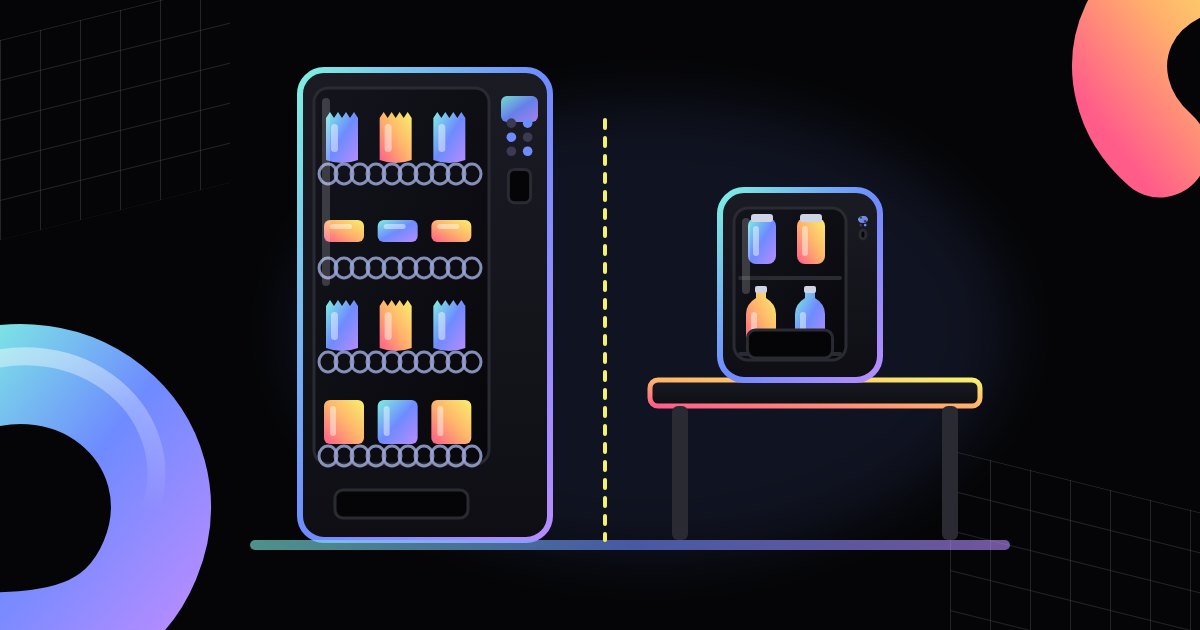
Tabletop or freestanding vending machine? A comparison of design, capacity, power, placement, and service access, plus tips on reading the dimensions on a spec sheet.
When people think of a vending machine, most picture a tall cabinet with a glass front standing against a hallway wall. That is only one format, though. Next to it there are smaller machines that sit on a countertop, a reception desk, a cabinet, or a dedicated stand. This article compares tabletop and freestanding vending machines: how they differ in design, capacity, and power, what placement and service access look like, where each type works best, and how to read the dimensions on a spec sheet. For an overview of all types of vending machines, see the separate article.
What tabletop and freestanding machines are
A freestanding vending machine stands directly on the floor. It has its own cabinet from the floor up to the top edge, and its frame is designed to carry the weight of the mechanisms, the stock, and any refrigeration unit. It is the most recognizable format, found in offices, schools, hospitals, and train stations.
A tabletop vending machine is smaller and does not stand on the floor but on a work surface: a countertop, a desk, a table, or a dedicated cabinet. It often takes the form of a coffee machine, a small snack machine, or a unit with a handful of drink selections. Manufacturers sometimes also offer stands or base cabinets that put such a machine at a comfortable height where there is no suitable counter.
The line is not always sharp
Some models can be used either way: on a counter or on a base cabinet that in practice turns them into a standing unit. You will also see terms such as compact machine or mini vending machine, which do not always mean the same thing. That is why it is better to go by the dimensions and installation notes in the documentation than by the category name alone.
Differences in design, capacity, and power
Both types work on the same principle: the customer picks a product, pays, and the controller triggers the dispensing mechanism. The differences come mainly from size and from how much room is left for each component.
Design and mechanisms
A freestanding machine has room for several trays of spirals, an elevator or another gentle delivery system, a large display, and a full payment module. The cabinet is usually steel and designed for use in public spaces. In a tabletop unit space is limited, so designers have to make choices: fewer trays, a simpler mechanism, or a smaller panel. Tabletop coffee machines similarly have fewer ingredient canisters and a smaller grounds bin.
Capacity
A smaller cabinet means fewer menu selections and fewer units of each product. In practice, a tabletop machine needs restocking more often at the same traffic level, or it fits places with less traffic. The manufacturer lists the exact number of selections and units on the data sheet for each model. Do not rely on general estimates, because models differ a lot.
Cooling
Freestanding machines for drinks or sandwiches usually have a full-size refrigeration unit and an insulated compartment. In tabletop units, cooling may be simplified or missing entirely, because many of them sell products that do not need to be kept cold. If you plan to sell chilled products, check the spec sheet to see whether the model has cooling and what temperature range it holds.
Power
Both types usually plug into a standard outlet, but their power needs can differ noticeably. A large refrigerated machine with lighting runs differently from a small snack machine without a compressor. Coffee machines heat water, so their power draw while making a drink can be high regardless of size. You will find the power ratings on the rating plate and in the manual. If you are not sure the electrical installation at a given spot is suitable, ask an electrician to assess it.
Placement and service access
How a machine is placed affects not only how it looks but also safety and ease of servicing.
Stability and the surface underneath
A freestanding machine is heavy, especially once loaded. It needs a level floor that can carry the load, and often leveling with adjustable feet. The manufacturer may also recommend anchoring it to the wall or floor to reduce the risk of tipping. A tabletop unit puts the demands on the furniture instead: the counter has to carry the weight of the machine with stock, and the machine itself should not slide around. Check the load rating of the counter with the furniture maker and the anchoring requirements in the machine's manual.
Ventilation and clearances
Any machine with cooling or a heater needs airflow. The manual usually specifies minimum clearances from the wall and other objects. With tabletop machines this is easy to get wrong, because they often sit in kitchen cabinetry or next to other appliances. Placing a machine too tightly can lead to overheating components.
Access for service
Restocking and servicing require opening the door, and sometimes pulling out trays or removing covers. In front of a freestanding machine you need room for the door to open fully and for the person servicing it to work freely. With a tabletop unit, keep in mind the space above and beside the machine, and sometimes the need to slide it forward. Also check that the outlet and any water connection can be reached without moving the whole machine.
Accessibility for users
The height of the buttons, the payment reader, and the pickup slot matters for customer comfort, including for wheelchair users and shorter people. With a tabletop machine the height depends on the counter, so it can be adjusted to some degree. With a freestanding machine the manufacturer's design decides. If accessibility matters at a given site, compare the layout of the controls across several models.
Where each type works best
Neither format is better across the board. The choice depends on the number of users, the available space, and the product range.
When to choose a tabletop machine
- in small offices and companies with a small team,
- in waiting rooms, reception areas, and service businesses,
- where there is a counter but no free floor space,
- as an add-on to a larger machine, such as coffee next to a snack machine.
The benefit is a smaller footprint and an easier fit into an existing interior. The limitation is lower capacity and a narrower product range.
When to choose a freestanding machine
- in factories, schools, hospitals, and universities,
- at train stations, shopping centers, and other high-traffic places,
- where a wide product range is needed, including chilled products,
- where the machine has to run unattended for long periods.
High capacity means fewer operator visits, and a sturdy cabinet stands up better to heavy use. You do need to find a suitable spot with access to power, though.
Talking to the operator
If an operator will place the machine, describe the site: the number of people, opening hours, available space, and the products you expect. An experienced operator will suggest a format that fits the conditions. The page about snack vending machines (publisher's site) shows examples of machines in both formats.
How to read the dimensions on a spec sheet
Dimensions are the first thing people check on a product sheet, but they are easy to misread. The other parameters are covered in the article on how to read a vending machine spec sheet.
Height, width, and depth
Manufacturers usually list the outer dimensions of the cabinet. Check whether the height includes the feet and whether the depth includes protruding parts such as the payment panel or the door handle. For a tabletop machine, add the counter height to the machine height and compare the result with any wall cabinets or shelves above it.
Clearance with the door open
Some sheets also list the space needed with the door open or the door's opening angle. If that information is missing, ask the manufacturer. It matters most in narrow hallways and alcoves, where the door can hit the wall.
Weight
The spec sheet usually gives the weight of the empty machine. Once stocked, the machine is noticeably heavier, which matters when assessing the load capacity of a counter, a floor, or the elevator used to bring it in.
Shipping dimensions
Do not forget the path the machine takes to reach its spot. Door widths, elevator sizes, and hallway corners can mean a large machine will not fit where it was meant to go. Measure the whole route before delivery and confirm the packaged dimensions with the supplier. Preparing the site is covered in more detail in the article on moving and installing a vending machine.
Security and resistance to damage
A machine in a public place has to withstand not only everyday use but also attempts to force it open and accidental knocks. Freestanding machines usually have a heavy cabinet, a reinforced door, and locks that make it harder to reach the stock and the cash box. A tabletop unit often has a lighter cabinet, and the machine itself is easier to move or lift. That is why smaller machines tend to go in supervised places, such as next to a reception desk, in an office open only to staff, or in a staffed waiting room. If the machine will stand somewhere without constant supervision, ask the manufacturer about anchoring it to the counter or wall and about the type of locks used.
Appearance and fit with the interior
The format also affects how the machine fits its surroundings. A large freestanding machine is a prominent part of the space: it draws the eye, but it also takes up a lot of room and can dominate a small area. A tabletop machine is easier to blend into an office kitchen or a reception area, especially when the cabinet color matches the furniture. Either way, good lighting and clear price labels help, because customers should know right away what they can buy and how to pay. Some manufacturers offer different color versions or graphic panels. Check the options available for a specific model.
Common mistakes when choosing
The first mistake is choosing a tabletop machine for a high-traffic spot. It empties quickly, and customers keep finding empty selections. The second is placing a large machine where it blocks a walkway or an exit route. The third is overlooking ventilation and service access, which only becomes obvious at the first breakdown. The fourth is relying on the category name instead of the actual dimensions and specifications in the documentation.
Summary
Tabletop and freestanding vending machines work on the same principle, but they differ in size, capacity, placement, and service needs. The smaller unit suits small teams and places with limited floor space. The larger one works well with heavy traffic and a wide product range. Before deciding, compare dimensions, weight, and power and ventilation requirements, and confirm the details of a specific model with the manufacturer or operator.
FAQ
Can a tabletop machine sell chilled products? Some models have cooling and others do not. Check the spec sheet for the specific machine.
Does a freestanding machine need to be anchored? That depends on the manufacturer's recommendations and the conditions at the site. The installation manual has the details.
Which format is cheaper to run? There is no general answer. The cost depends on the model, the product range, how often it is restocked, and the terms of the contract with the operator.