How does a vending machine's refrigeration unit work? Learn what the compressor, condenser, evaporator, and fans do, why the unit needs airflow, and when to call for service.
The cold inside a refrigerated vending machine comes from a set of parts you usually never see: the refrigeration unit. It sits tucked away inside the cabinet, and most of the time the only signs of it are a low hum and warm air coming out of a grille. This article explains what the unit is made of, how it works, why it switches on and off from time to time, and why it depends so much on free airflow. At the end, you will find the signs that the unit needs service. To learn about the fluid that circulates in the system, read our article on refrigerants in vending machines.
What a refrigeration unit is and where it sits
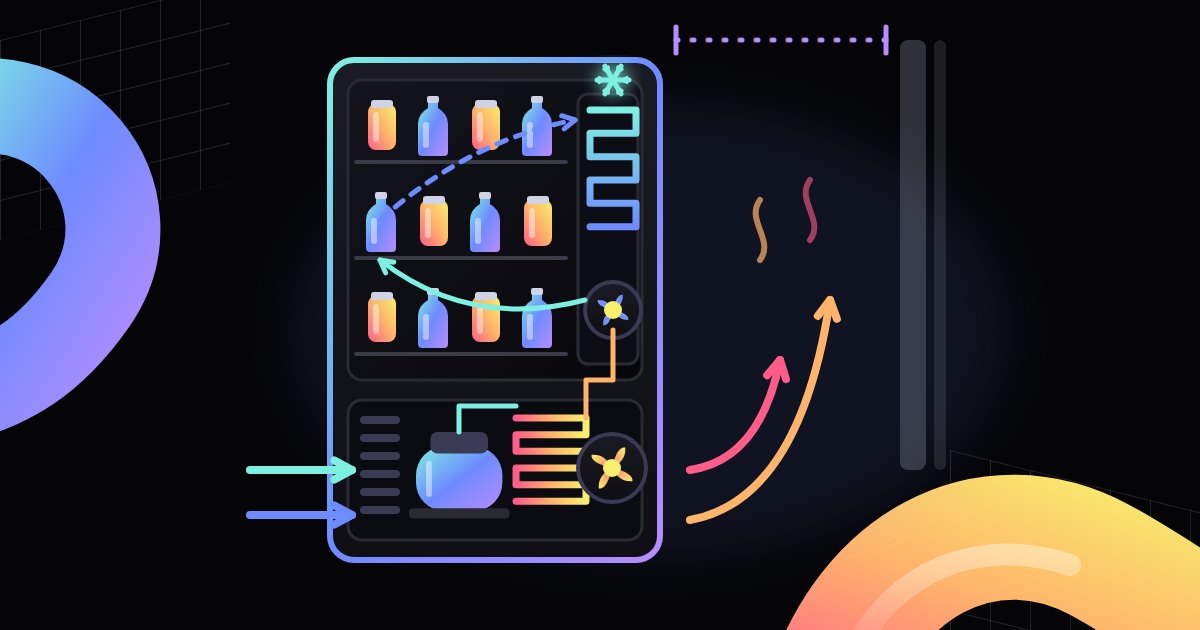
A refrigeration unit is a group of components that removes heat from inside the machine and releases it into the room. In everyday speech, people often use the word for the compressor alone, but it usually means the whole assembly: the compressor, the condenser, the fan, and the lines that connect them. Together with the evaporator in the product cabinet, the unit forms a sealed refrigeration system in which the refrigerant circulates.
Every refrigerated machine has one: beverage machines, combo machines that sell both drinks and snacks, and equipment such as vending coolers (publisher's site). In many models, the unit sits at the bottom of the cabinet, below the product area. Less often, it is mounted at the top or at the back. In some machines, the entire unit is built into a slide-out cassette that a technician can remove and replace as one piece. The exact location and how to reach it are described in the documentation for the specific model.
Compressor, condenser, evaporator, and fans
Each part of the system has its own job. Only together do they form a cycle that keeps moving heat from inside the machine to the outside.
Compressor
The compressor is the heart of the system. It compresses the refrigerant and keeps it moving so it can circulate through the cycle. It is usually the part you hear most: a steady, low hum while cooling is on is perfectly normal.
Condenser
The condenser is a heat exchanger, most often a set of tubes with closely spaced fins. Hot refrigerant flows through it and gives off heat to the air in the room. That is why warm air comes out near the unit. The condenser works well only when air can flow through it freely.
Evaporator
The evaporator sits inside the machine, usually behind a cover at the back of the cabinet or above it. This is where the refrigerant absorbs heat from the air in the cabinet, so the evaporator is the coldest part of the machine. Moisture and sometimes frost collect on it, which is why machines have ways to defrost it and drain the condensate. To learn where water in a vending machine comes from, read our article on condensation in vending machines.
Fans
Many machines use two kinds of fans. The condenser fan pushes room air through the condenser and blows it out warmed. The evaporator fan moves cold air around the cabinet so the cold reaches every shelf. When either fan stops working, cooling gets weaker, even if the compressor is running normally.
Why the unit switches on and off
The refrigeration unit does not run nonstop. A thermostat or the machine's controller measures the temperature in the cabinet and compares it with the value the operator has set. Once the inside has cooled to the set level, the compressor switches off. When the temperature rises again, the compressor starts back up. This on-and-off cycling is how the system normally works, not a sign of a fault.
How long each cycle lasts depends on many factors: the room temperature, how often the door is opened, how much freshly loaded, still-warm stock is inside, and the condition of the unit itself. After restocking, the compressor usually runs longer because it has to cool down the new products. In many models, the controller also pauses cooling from time to time to defrost the evaporator. Some controllers wait a short while after a power interruption before restarting the compressor. The manufacturer's manual has the details.
Two extremes are a cause for concern: a compressor that practically never switches off, and one that switches on and off very often for short periods. Both are worth reporting to a service technician.
Airflow and space around the machine
The unit can only remove as much heat from the cabinet as it can release into its surroundings. If the warm air from the condenser has nowhere to go, it lingers around the machine and returns to the condenser even warmer. The compressor then runs longer, and cooling gets weaker. That is why free airflow matters to the unit just as much as working parts do.
The manufacturer specifies where the machine draws in and exhausts air. This is most often done through grilles at the bottom of the front or at the back or side of the cabinet. The manual also lists the minimum clearances from walls and other objects. It is worth following them when you set up the machine and later on, when new furniture or boxes appear nearby.
What makes it harder to release heat
- blocked ventilation grilles, for example from a trash can, boxes, a brochure stand, or another unit placed too close,
- a machine pushed into an alcove or set closer to the wall than the manufacturer allows,
- dust and dirt on the condenser fins, which act like insulation and make heat transfer harder,
- nearby equipment that gives off heat itself, especially if its exhaust points toward the machine,
- direct sunlight and a warm room, where the air reaching the condenser is already warm.
To learn more about how location affects cooling, read our article on ambient temperature and vending machines.
Airflow inside the cabinet
Airflow matters on the inside too. The evaporator fan needs a path that lets cold air spread through the cabinet. Products packed tightly all the way to the back wall, boxes left on the cabinet floor, or blocked openings in the evaporator cover mean that some shelves cool less well. When you restock, follow the product layout and do not fill spaces the manufacturer did not intend for products.
What the operator can do
- check regularly that the ventilation grilles are clear,
- clean dust off the condenser as the manufacturer's manual describes, or leave it to a service technician,
- do not push the machine closer to the wall than the manufacturer allows,
- check the door gaskets and do not leave the door open longer than necessary,
- log the temperature and report any deviations.
Do not open the refrigeration system or try to add anything to it. Work on refrigeration systems requires the proper qualifications, and work involving fluorinated refrigerants requires F-gas certification.
Signs that the unit needs service
A few signs should prompt a call to a service technician:
- the cabinet temperature keeps rising and does not return to the set value,
- the compressor runs almost nonstop or keeps switching on and off,
- no warm air comes out of the grille while cooling is on, or you cannot hear the fan,
- new noises appear, such as knocking, rattling, or loud buzzing,
- a thick layer of ice builds up on the evaporator, or water appears under the machine,
- the controller shows a cooling error message.
Before you call for service, check the simple things first: whether the grilles are blocked, whether the door closes properly, and whether anyone has changed the temperature settings. If that does not help, note when the problem started and what you see or hear, and have the machine's model and serial number ready. This information helps the technician prepare for the visit.
Summary
A refrigeration unit is a compressor, a condenser, and a fan that, together with the evaporator, move heat from inside the machine into the room. Switching on and off in cycles is normal, and warm air at the grille is a sign the system is working. The most helpful thing you can do for the unit is to look after its airflow: clear grilles, a clean condenser, wall clearance that follows the manual, and sensible loading of the cabinet. Leave any work on the refrigeration system itself to qualified technicians.
FAQ
Is it normal for a vending machine to blow out warm air? Yes. The unit releases the heat it removes from the cabinet into the room, so you can feel warm air at the grille. What should worry you is the lack of warm air while cooling is on.
Should the refrigeration unit run nonstop? No. It usually switches on and off in cycles controlled by a thermostat or the controller. Running longer after restocking or on a hot day makes sense, but running almost nonstop for a long time is a reason to have it checked.
How close to a wall can a vending machine stand? That depends on the model and on where the machine draws in and exhausts air. The manufacturer lists the minimum clearances in the manual. If you do not have it, ask the manufacturer or supplier and give them the model and serial number.
Can I clean the condenser myself? If the manufacturer's manual lists it as an operator task, do it exactly as described there. When in doubt, leave the cleaning to a service technician.
Who can repair a refrigeration unit? Repairs to the refrigeration system are done by a technician with the proper qualifications. The operator can look after airflow and cleanliness and report faults to the service team.