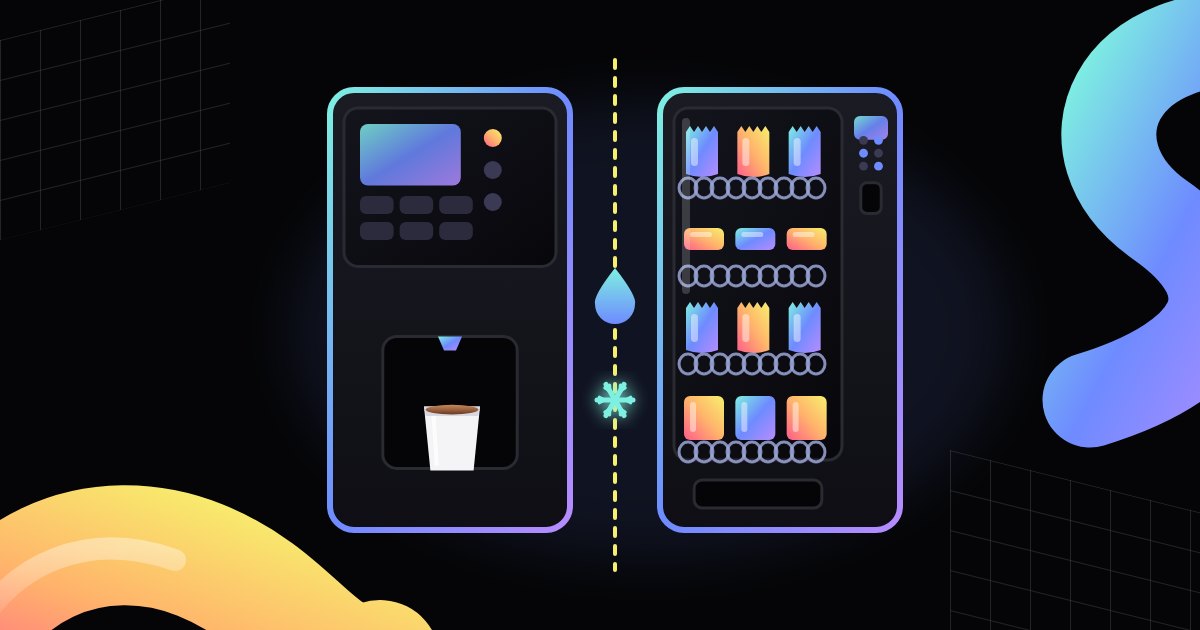
How coffee machines differ from snack machines: water, brewing unit, cooling, cleaning, and upkeep.
From across the room, a coffee machine and a snack machine look like cousins. Both are tall boxes with a screen, a payment reader, and a slot where something comes out. Both hum quietly in a corner. But open the front door of each, and the family resemblance ends. One is a small kitchen. The other is a well-organized shelf. That difference shapes where each machine can stand, what it needs from the building, and how much care it asks for. This post walks through the technical differences between coffee machines and snack machines, so you know what you are signing up for before either one arrives.
Making vs. handing over
The core difference is simple. A coffee machine prepares a drink on the spot. It takes water, heats it, grinds or doses coffee, mixes in milk or other ingredients, and pours the result into a cup. Every drink is made fresh, a little like a barista working at high speed. A snack machine does not make anything. It stores packaged products and hands them over when someone pays. The chocolate bar was finished in a factory long before it reached the spiral. Everything else follows from this. A machine that makes things needs ingredients, water, heat, and cleaning. A machine that hands things over needs space, a good mechanism, and usually cooling. Keep that in mind, and the rest of this post will feel obvious.
Water: the biggest practical difference
A coffee machine needs water. Some models connect to the building's water supply. Others use a tank that someone refills by hand. A direct connection means nobody has to carry water, but it ties the machine to a spot near a pipe. A tank gives more freedom of placement, but it needs regular attention. Which option a model supports is described by its manufacturer. A plumber can say whether a connection is practical at your site. A snack machine needs no water at all. That is a big advantage when you are choosing a spot. It can stand in a corridor, a lobby, or anywhere with a socket and enough floor. A coffee machine has to think about pipes, drains, and spills. A snack machine just has to think about the floor.
Power and heat
Both machines need power, but they use it differently. A coffee machine heats water, often quickly and repeatedly, so heating is a major part of its energy use. Some models also cool milk or other ingredients. A snack machine uses power mainly for cooling, lighting, the controller, and the motors that turn the spirals. Which machine draws more, and when, depends on the model and how it is used. The exact requirements are on the rating plate and in the manual. An electrician can confirm that the socket and circuit are suitable for each machine. If both are planned for the same spot, ask whether one circuit can handle them together. It is a short question that can save a tripped breaker on a busy morning.
Inside a coffee machine
A coffee machine contains several working parts that each do one job. A typical set includes:
- a water system with a tank or a supply connection,
- a heater or boiler,
- a brewing unit, sometimes with a grinder for beans,
- canisters for ingredients such as coffee, milk powder, chocolate, or sugar,
- mixers that combine powders with hot water,
- a cup dispenser, unless people use their own cups,
- a drip tray and a waste container for used coffee grounds.
Not every machine has every part. A bean-to-cup model grinds coffee fresh. An instant model mixes soluble coffee with water. Some use fresh milk, others powder. The manufacturer's documentation says what a given model contains. All of these parts touch food, water, or both, and that is why cleaning matters so much.
Inside a snack machine
A snack machine is simpler on the inside. Products sit on spirals, one product type per spiral. When someone pays, the controller turns a motor, the spiral rotates, and the product moves forward until it drops into the delivery bay. Many machines use a sensor to confirm that something actually fell. If it didn't, the machine may try again or refund the customer, depending on its settings. Most snack machines have a cooling unit to keep chocolate and other products from going soft. Some have temperature zones for drinks. The rest is a cabinet, shelves, lighting, a payment system, and a controller. There is no water, no heat, and no mixing. That is not a weakness. It is the reason snack machines are often easier to live with.
Cleaning: daily routine vs. occasional wipe
Cleaning is where the two machines differ most in daily life. A coffee machine needs regular cleaning of the brewing unit, the mixers, and everything that touches ingredients. Milk systems in particular need careful attention. The manual describes what to clean, how, and how often, and many machines have built-in cleaning programs. Usually the operator handles this, sometimes with help from someone on site for simple tasks like emptying the drip tray. A snack machine mostly needs the inside of the cabinet and the delivery bay cleaned, plus the glass and the keypad. Nothing is brewed, so nothing builds up in pipes. If your site has nobody willing to touch a machine between operator visits, that alone may tip the decision.
Refilling: ingredients vs. products
Refilling also looks very different. A coffee machine is refilled with coffee, milk or milk powder, chocolate, sugar, cups, and stirrers, depending on what it serves. The operator measures and pours ingredients into canisters. Each drink uses small amounts, so one refill can last a while, but several ingredients run out at different speeds. A snack machine is refilled with packaged products according to the planogram, the plan that shows what sits on which spiral. The operator removes products past their date and adds new ones. It is more like stocking a small shop. In both cases, telemetry can tell the operator what is running low. In a coffee machine, that might be milk. In a snack machine, it is usually the most popular chocolate bar.
Service and faults
Every machine breaks sometimes. The types of faults differ. A coffee machine has more moving and heated parts, so issues often involve the brewing unit, water flow, scale buildup, or a mixer. Hard water can make scale a bigger concern, which is why many machines use filters, as the manual describes. A snack machine has fewer parts that touch food. Typical issues involve a spiral that doesn't turn, a product that gets stuck, a sensor, or the payment reader. Both machines rely on payments working, so a broken card reader stops sales either way. The operator handles repairs according to the agreement. For the host, the practical step is the same for both: report faults quickly, using the contact details on the machine.
Hygiene and ingredients
A coffee machine handles ingredients that go straight into a drink. That makes hygiene part of the daily routine, not an occasional task. Ingredients have their own storage instructions and dates, which come from the producer's label. Allergens such as milk are something users may ask about, and the information comes from the product labels and the operator. Food rules that apply to preparing drinks are the operator's responsibility, and questions about them belong with the relevant authorities or a qualified advisor. A snack machine sells sealed products, so the producer has already taken care of what is inside the package. The operator still has to keep the cabinet clean, check dates, and store products as the label says. The work is lighter, but it is not zero.
Placement needs side by side
The placement checklist overlaps, but not completely. Both machines need a stable, level floor, a suitable socket, and space for ventilation as the manual describes. Both should stay clear of escape routes and doors, and the person responsible for the building can say where that is a concern. A coffee machine adds a few items. It may need a water connection or room to refill a tank. It produces some heat and steam, so it shouldn't stand under a sensitive smoke detector without checking. It benefits from a nearby bin for cups and stirrers. A snack machine needs a spot where people can see the products. Neither machine likes direct sun or a radiator next to it.
Can they stand side by side?
Yes. In offices, factories, and other workplaces, coffee and snack machines often stand next to each other. It makes sense. People who buy coffee often want something to go with it, and people buying a snack may want a drink. Putting both in one break area creates a small corner where people actually take a break. A few practical points help. Make sure there is enough power for both, as the electrician confirms. Leave clearances between and around them as each manual describes. Keep the coffee machine's water connection or tank access clear. If one operator handles both machines, service visits can be combined. If two operators are involved, it helps to know who to call for which machine.
Related reading: How Combo Machines Combine Snacks and Drinks in One Unit and Types of Vending Machines.
FAQ
Which machine is easier to maintain? Usually a snack machine, since it has no brewing unit, water system, or mixers to clean.
Can they stand side by side? Yes, that is common in offices and facilities. Check power, clearances, and access to the coffee machine's water supply.
Does a coffee machine always need a water connection? No. Some models use a tank that is refilled by hand. The manufacturer's documentation says which options a model supports.
Does a snack machine need cooling? Usually yes, to keep products such as chocolate in good condition. The manual describes how cooling works in a given model.